
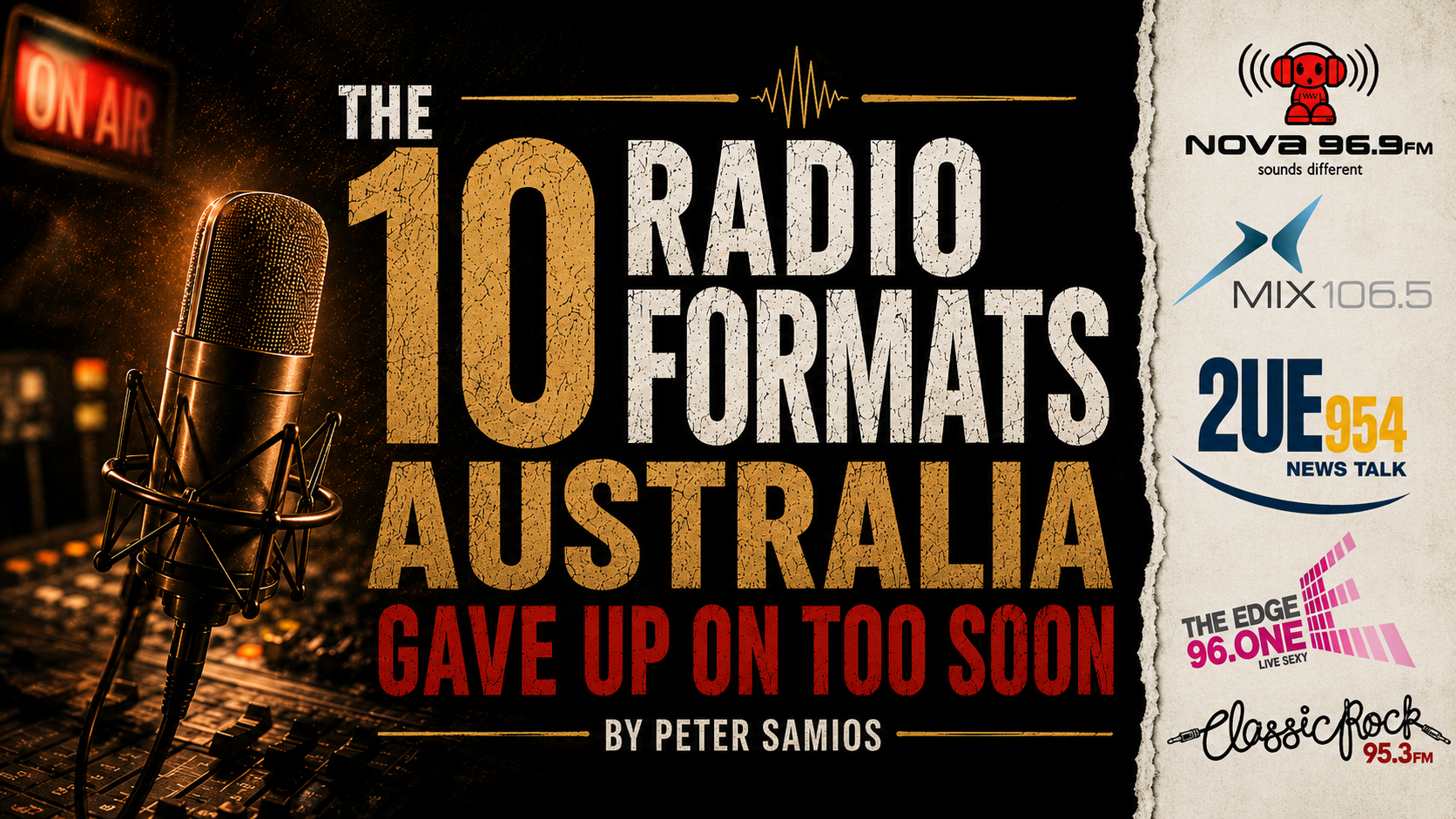
Killed Too Soon: The 10 Formats Australian Radio Should Have Kept
10. Zoo Soft Rock
Before Super Radio Network’s DAB+ station ZOO Super Digi became the broader music-variety station many listeners later knew, it occupied a very clever piece of musical real estate: soft rock.
ZOO was one the multiple additional Sydney DAB+ licences acquired by the Super Radio Network operation in 2009, alongside Gorilla Super Digi, FUN Super Digi and DANCE Super Digi.
Historical digital-radio listings specifically identify ZOO Super Digi as a digital-only Soft Rock service before its later evolution into ZOO Music Variety.
What I liked about the original idea was its positioning. Musically, it sat in a space between the harder rock attitude of 104.9 Triple M Sydney and the classic-hits territory of WSFM101.7. That is a very usable lane in Sydney radio.
It wasn’t trying to out-rock Triple M or out-gold WSFM.
It could take the melodic end of rock, familiar adult songs and softer guitar records and build an identity around them.
9. smoothfm “Your Easy Place To Relax”
When smoothfm launched in Sydney and Melbourne on 21 May 2012, its original proposition was wonderfully disciplined: “Your easy place to relax.”
Michael Bublé fronted the launch and the product was built around mood and familiarity rather than simply another conventional era-based AC playlist. That restraint mattered.
The original smoothfm understood something programmers occasionally forget: a radio station doesn’t always need to create excitement. Sometimes its competitive advantage is the feeling it creates when somebody turns it on.
The slogan eventually became “Your Feel Good Station” in 2020 as the format evolved.
smoothfm remains an extraordinary Australian radio success story. But there was a purity about that original “easy place to relax” proposition that I still think was special.
8. WSFM101.7 “Good Times & Great Classic Hits”
This was WSFM when the brand proposition was almost impossible to misunderstand.
Good Times & Great Classic Hits.
There was warmth in it, but importantly there was also musical breadth. The station could comfortably accommodate major rock records, Australian classics, pop, disco and genuine catalogue surprises without feeling as though somebody had accidentally loaded the wrong playlist.
Contemporary records from the era confirm WSFM was firmly presenting itself around “great classic hits”, and the positioning became synonymous with the station for years.
It felt like somebody actually liked the record collection.
That’s different from simply constructing one.
7. Triple M Sydney “returns to rock”
After the “You’ll Never Know What We’ll Play Next” experiment this is the Triple M era I want back on this countdown.
Not the preceding “You’ll Never Know What We’ll Play Next” experiment itself, but what happened when 104.9 Triple M began rediscovering the identity Sydney had known it for. Triple M ROCKS.
The Jack-style experiment beginning around 2005 had broadened Triple M’s music dramatically under “You’ll Never Know What We’ll Play Next”.
Historical accounts show that by the period following that experiment, the station was moving back towards its rock positioning before another major reinvention arrived at the end of 2008.
And that mattered because ROCKS wasn’t merely a slogan.
For generations of Sydney listeners, those famous Triple M ROCKS bumper stickers represented the brand.
Rock was the station’s permission to be louder, irreverent, blokey, musical and unmistakably Triple M. There is enormous equity in an audience knowing exactly what you stand for.
Triple M has reinvented itself numerous times since, but this period reminded us of one of radio’s most valuable lessons: sometimes the cleverest format move is not finding something new. It’s reclaiming what you already own.
6. Classic Rock 95.3FM
This one still fascinates me.
When vega was replaced by Classic Rock 95.3FM in March 2010, the proposition suddenly became brutally clear: classic rock, all day.
DMG’s own material described it as the only dedicated pure Classic Rock format servicing Sydney and Melbourne, built around artists including AC/DC, INXS, U2, Pink Floyd, Jimmy Barnes and Led Zeppelin.
In Sydney, Anthony Maroon handled Breakfast. That’s a station you can explain in five seconds. Yet Sydney’s Classic Rock identity lasted only from March 2010 until March 2011, before the frequency became 95.3FM and eventually smoothfm. One year.
Radio formats, particularly new ones, require habit formation.
Audience perception doesn’t move at the same speed as a programming meeting.
5. The Edge 96.ONE “Live Sexy”
There was something wonderfully un-corporate about this version of The Edge 96.ONE.
The station had already established strong credentials around Hip Hop and R&B, but the “Live Sexy” era broadened the sound and wrapped it in a younger, cheekier, attitude-driven brand.
And then there was Mike E and Carmela. Their Breakfast show became enough of a talent story that ARN subsequently took them across to Mix 106.5.
That alone says something about what The Edge was developing. This was radio with swagger. Not everything had to be explained through research terminology.
The name, attitude, presenters and music created a feeling.
4. Mix106.5 & Mix101.1 “The Fresh Mix Era”
For a brief period, ARN decided the word Mix could actually mean something fresh.
Sydney’s Mix 106.5 underwent a major 2010 refresh, adopting “Sydney’s Fresh Mix” and deliberately moving its music demographic younger. Mike E and Carmela were brought across from The Edge for Sydney Breakfast, giving the station a completely different energy.
What interests me most is how quickly it disappeared. By December 2010, Mix106.5 had returned to “Sydney’s Best Mix of the ’80s, ’90s and Now” and brought Love Songs back into daytime programming.
That’s less than a year to reposition an established FM brand, retrain an audience and build a completely different listening habit. Maybe Fresh Mix was wrong. Or maybe it simply wasn’t allowed enough time to prove it was right.
Either way, to me it marked the early stages of what KIIS1065 could have sounded like. Given what has recently occurred at KIIS1065, this Mix106.5 format could even stand a chance in 2026.
3. Triple M “Music That Rocks”
At the end of 2008, Triple M Sydney made another significant move.
Following its temporary Awesome ’80s stunt, “The All New Triple M” launched under “Music That Rocks”, deliberately targeting a younger 25–39 audience.
Ugly Phil and Sami Lukis took Breakfast. Roy & HG appeared in Drive on Mondays and Fridays, Byron Cooke hosted Live Line Tuesday to Thursday, Peter Berner returned in evenings and Paul Murray also featured at night.
But the most interesting component was the music.
You could hear Powderfinger, Silverchair, Sneaky Sound System, Kings of Leon, Coldplay, Snow Patrol and Faker alongside AC/DC, Cold Chisel, Bon Jovi and Nickelback.
That is exactly the question rock radio continually has to answer: How do you honour the heritage without turning the format into a museum? This Triple M was trying.
2. 2UE “A Younger Version of Talk Radio”
This will probably be one of the most debated inclusions. Good.
When Jason Morrison took over 2UE Breakfast in 2011, the station had the ingredients to pursue something Australian commercial talk radio still hasn’t completely cracked: making talkback feel relevant to an audience younger than traditional AM radio’s core.
Morrison was anchoring 2UE Breakfast during the 2011 relaunch period, alongside David Oldfield in Mornings & Paul Murray at Drive. It made 2GB sound like the daggy oldies talk station.
The opportunity wasn’t to make talk radio “young” by pretending to be FM. It was to make it faster, contemporary, immediate and culturally relevant, while retaining the authority, callers, interviews and argument that make talk radio powerful.
Radio sometimes assumes younger listeners don’t want spoken-word content.
Podcasting has spent the past decade demonstrating the opposite.
1. Nova96.9 “Sounds Different”
Nothing else could be number one. This is the ultimate definition of an industry disruptor.
Nova96.9 launched in Sydney on 1 April 2001, the city’s first new commercial FM launch in roughly two decades, under two words that became one of Australian radio’s great brand promises: SOUNDS DIFFERENT.
Merrick & Rosso launched Breakfast, with Christine Anu as the first guest. The broader original lineup included Bianca Dye in Mornings, Kip Wightman in Afternoons, Ugly Phil in Drive and Rabbit at Nights.
But Nova’s real breakthrough was philosophical.
Research told the launch team listeners were tired of repetitive songs, long advertising breaks, cheesy radio and predictable promotions.
Nova responded with genre collision, no more than two ads in a row, localism, irreverence and presenters who were allowed to have personalities.
A May 2001 music log tells you everything. Within an hour Nova could move through The Living End, Fragma, Incubus, Heavy D & The Boyz, The Offspring, Salt-N-Pepa and Powderfinger.
Try putting that through a conventional music meeting. That was the point.
Nova didn’t simply launch another station. It challenged the rules everybody assumed commercial FM needed to follow.
Over time, inevitably, Nova evolved. But I still believe Australian radio surrendered something important when “Sounds Different” became less of a programming philosophy and more of a chapter in radio history.
Peter Samios' Countdown
10. ZOO Soft Rock
9. smoothfm: Your Easy Place To Relax
8. WSFM 101.7: Good Times & Great Classic Hits
7. Triple M Sydney: The Return of ROCKS
6. Classic Rock 95.3FM
5. The Edge 96.ONE: Live Sexy
4. Mix 106.5 / Mix 101.1: Fresh Mix
3. Triple M: Music That Rocks
2. 2UE: The Younger Talkback Opportunity
1. Nova96.9: Sounds Different
The Bigger Issue
Look across this countdown and there’s a common thread.
These stations had positions.
Not just playlists. Not just research clusters. Not just another variation of “the greatest hits”, “the biggest variety” or “the music you love”.
You knew what they stood for. And somewhere along the way, commercial radio became very good at eliminating reasons for listeners to dislike a station.
I’m not convinced that’s the same thing as giving people a reason to love one.
The best formats polarise a little. They create tribes. They own music. They own personalities. They create bumper stickers people actually want on their cars.
Radio programmers will disagree with my ranking. I hope they do.
Because my bigger question for the Australian radio industry is this: Which format did we kill before we’d actually discovered how big it could become?

Peter Samios
Radio Coach & Consultant
Peter Samios is a four-time Australian Commercial Radio Awards (ACRA) winner, former Content Director and media strategist who helped lead a regional Australian radio station to Number One for the first time in its history. Having worked alongside some of Australia's biggest radio personalities including John Laws, Jonesy & Amanda and Richard Mercer, Peter now coaches radio hosts, content teams and media professionals through Radio Mastery, helping them dominate their market and reach Number One.